
Erasmus Student Network (ESN) welcomes the publication of the Action Plan for the Pact for the Mediterranean and recognises its ambition to foster a Common Mediterranean Space built on people, shared prosperity, and security. As the largest Erasmus+ student and Alumni association in Europe and an organisation with long-standing experience in supporting student mobility, intercultural dialogue, and youth empowerment, ESN wishes to highlight several areas where student and youth civil society can — and should — play a more active role.
1. Mediterranean University: Students Must Be Named Stakeholders
The establishment of Mediterranean University consortia, supported by EUR 11 million in NDICI funding and EUR 15.2 million through Erasmus+ Capacity Building in Higher Education, represents a historic opportunity to build a truly inclusive transnational education space. ESN strongly advocates the explicit inclusion of Erasmus+ students and alumni as key actors in the decision-making processes of these consortia's governance structures. Student voice is not a complement to institutional cooperation — it is its foundation.
In this regard, ESN calls on the European Commission to ensure that the upcoming UfM Higher Education Ministerial Meeting (Q3 2026) and the establishment of the UfM Higher Education Platform formally incorporate student representation. We also highlight the Mediterranean Student Summit, co-organised by ESN and UNIMED, as an existing and proven co-creation mechanism that can feed directly into this process.
Furthermore, ESN underlines the critical role of quality assurance and recognition in making joint programmes and micro-credentials meaningful. Our ongoing cooperation with ENQA — including the QACHE project on cross-border higher education quality assurance — and our work with the ENIC-NARIC network demonstrate that robust recognition frameworks are indispensable for any joint academic initiative in the Mediterranean region. These frameworks must be integrated from the outset, not treated as an afterthought.
2. Youth Parliamentary Assembly: Build on Existing Civil Society Structures
ESN strongly supports the creation of a Youth Parliamentary Assembly for the Mediterranean, with its first plenary planned for Q4 2026. However, we note that the current Action Plan does not name youth civil society networks or National Youth Councils among the stakeholders involved in its design. We believe this is a missed opportunity.
ESN calls for the involvement of National Organisations from Erasmus Student Networks and National Youth Councils in the Assembly's design and governance. Young people who have experienced cross-border mobility first-hand — Erasmus+ students and alumni — are uniquely positioned to represent a genuinely Mediterranean civic perspective. Their inclusion would strengthen the legitimacy and impact of the Assembly from the beginning.
3. MED Skill Tracker: Mobility Experience Must Count
The MED Skill Tracker initiative, with its pilot phase launching in Q4 2026, aims to document and recognise skills across the region using tools such as Europass and ESCO. ESN fully supports this initiative and urges that non-formal learning and student mobility experiences be explicitly included in the tracker's scope, not only formal vocational or professional training.
ESN also offers its ESNsurvey as concrete evidence base for the pilot's design. Our most recent findings on mobility patterns in Regions 3 (Southern Mediterranean) and 9 (Sub-Saharan Africa) reveal significant imbalances in mobility flows, a high concentration of mobility in a small number of destinations, and persistent gaps in support structures and recognition mechanisms. These findings should directly inform the identification of the three pilot countries and priority sectors (Q2 2026).
4. Talent Partnerships: Address Mobility Imbalances Structurally
ESN welcomes the ambition of scaling up Talent Partnerships to train approximately 7,000 participants and facilitate 6,500 mobilities by Q4 2026. We stress, however, that sustainable and balanced mobility requires more than logistics — it requires trust, recognition, and support structures that work equally well for students coming from the southern Mediterranean into the EU and vice versa.
The ESNsurvey data consistently show that mobility from the southern Mediterranean region remains underrepresented and structurally disadvantaged. ESN calls on the Commission to treat these findings as a policy input and to ensure that Talent Partnerships are designed to actively correct, not replicate, existing imbalances.
ESN stands ready to engage as an active partner in implementing the Pact for the Mediterranean Action Plan. We bring a unique combination of grassroots presence, data on student mobility, and institutional partnerships — including UNIMED, UfM, and HEIs — that can contribute concretely to the initiatives outlined above. We look forward to continued dialogue and to being formally included in the stakeholder structures that are currently being designed.
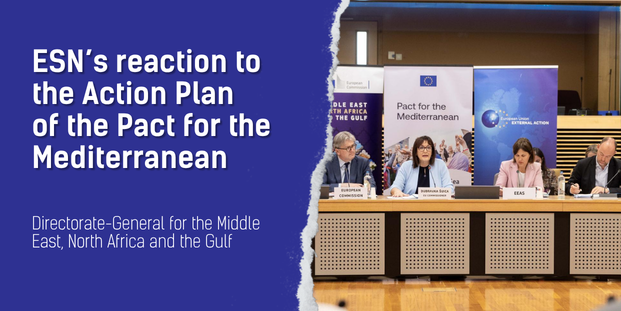
Copyright notice: The cover image is sourced from the European Commission website. © European Union, European Commission. Used for editorial and informational purposes.
Follow ESN