
On 29 September 2026, the DiEM (Diversity and Inclusion in Erasmus+ Implementation) consortium hosted a full-day stakeholder event in Brussels, bringing together representatives from across Europe to explore how the Erasmus+ programme can become more accessible and beneficial for participants with diverse profiles, particularly those facing additional barriers.The full-day event included a variety of engaging discussions, interactive sessions and spaces for connection between students, higher education institutions and policymakers.
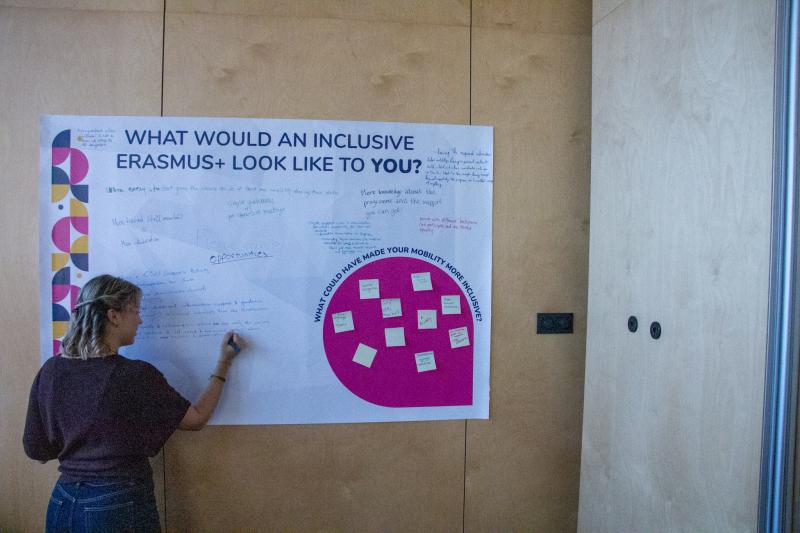
The day started with a warm welcome by Wim Gabriels, Erasmus Student Network (ESN) and Nikolina Đurić, Academic Cooperation Association (ACA), successfully setting the scene for a conference based on a good atmosphere, inclusion and connection. They emphasised that inclusion cannot be an afterthought in Erasmus+, but instead constitutes the heart of mobility. Putting this value into practice, participants were invited to share their own thoughts and experiences regarding inclusive mobility on the Inclusion Wall, a creative canvas especially designed for the event. This heartfelt opening was followed by Neli Kalinova-Schmieder (ESN) sharing insights of DiEM’s work over the past two and a half years, raising awareness about persisting barriers to student mobility, including challenges before, during and after the mobility experience. She drew attention to the research findings of the DiEM report, highlighting areas that have improved and challenges remaining to be addressed. She also presented the main outputs of the project, including a virtual assistant and an inclusion heatmap to assist students, toolkits and guidelines for university staff and frameworks to inform policymakers.
In the following discussion panel centred on Student Experiences and the Diversity of Needs, moderated by Juan Rayón González (INGENIUM European University), representatives of different student groups came together to explore the specific needs and challenges in their field. Nath Jonniaux (Haute Ecole de la Province Liège) highlighted the administrative and social barriers for LGBTQ+ students while studying abroad and Katerina Karanika (Rural Youth Europe) emphasised the dangers of expecting everyone to possess the same taken-for-granted knowledges and skills without providing further support in new settings. Bálint Koós (ESU) emphasised the lack of capacity and know-how in universities to support the diversity of students. Possible solutions discussed included strengthening peer support structures, allowing for mobility windows and providing bureaucracy support workshops. The session finished with a conclusion highlighting the common barriers amongst student groups, such as lack of sufficient financial support, psychological challenges and disconnection between diversity experts and broader institutional ecosystems to counter systemic issues on the ground.
The second panel of the day, moderated by Melih Özkardes (ENHANCE University Alliance), focused on Institutional Support and Inclusive Universities. Daniel Dzida (Accessibility Centre, Jagiellonian University in Krakow), Lukáš Pospíšil (Agricultural University of Iceland), Aleksandra Kjakste (University of Latvia) and Christos Vazouras (ESN Sweden) discussed good practices applied by institutional actors as well as challenges and capacity problems that they face in providing support for mobility students from diverse backgrounds. The discussion balanced important aspects including the need for more communication and collaboration with students as well as between institutions, the importance of institutional commitment in the form of an inclusion-oriented leadership and the obstacle of increasing workload for staff.
The afternoon started with an Inclusion Café and Good Practice Exhibition, featuring posters and case studies of successful inclusion initiatives across the higher education sector. This part of the event featured 10+ presenters from diverse backgrounds, focusing on a wide range of topics: from projects targeting specific topics such as mental health support or queer mobility, over local case studies, to broader research outputs, participants were able to gain new inspirations and insights.
Afterwards, space was given to the participants’ insights in collaborative breakout sessions with the aim of ‘Co-Creating an Inclusive Erasmus+ Programme’. Following the DiEM framework for barriers and challenges in participation in student mobility, participants chose between three groups, with each group discussing barriers at different levels of student mobility: the programme level (facilitated by Julia Österbauer-Vabitsch, OeAD and Martin Bogdan, ACA), the institutional level (facilitated by Dr Ewa Krzaklewska, Jagiellonian University in Krakow and Christina Bohle, Humboldt-Universität zu Berlin) and the individual level (facilitated by Tiago Nunes, ESN and Meret Stursberg, ESN). These highly interactive sessions allowed all participants to take part in the discussion by developing policy recommendations and questions for policymakers that were presented in the final policy panel.
Next, moderated by Mădălina Băndărău (ESN), voice was given to ESN volunteers, presenting Student Policy Pitches. Lukas Zehner (ESN Finland) and Sam Watson (ESN UK) presented a reflection on personalised pre-departure support for students with disabilities regarding access to accommodation. Sandra Rusnáková (ESN Slovenia) addressed administrative barriers for first-generation students and Despoina Blachoura (ESN Greece) and Robert Rascol (ESN Romania) proposed ideas to ensure access to health care for students with disabilities before and during their Erasmus+ stay, under the motto that no student should have to choose between their health and an Erasmus experience. Finally, these pitches were responded to by a representative of the European Commission, Alessandro Senesi (DG EAC), who encouraged students and alumni to actively inform policymaking processes, for example by participating in conferences like this one.
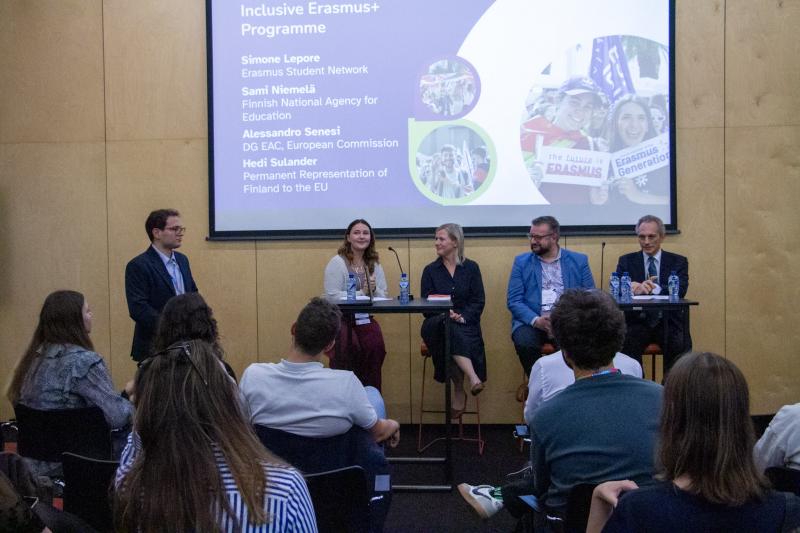
Finally, Simone Lepore (ESN) invited Alessandro Senesi (European Commission), Sami Niemelä (Finnish National Agency for Education) and Heidi Sulander (Permanent Representation of Finland to the EU) to a roundtable discussion between policymakers, participants and breakout session representatives, addressing the systemic implementation of the inclusion and diversity programme priority. Here, challenges such as limited funding, bureaucratic barriers and recognition issues were investigated from multiple perspectives, pointing towards the need to strengthen existing structures and networks, rethink current frameworks and provide better support for institutions.
The day closed with Wim Gabriels (ESN) reminding of the urgency of inclusion at this particular moment, considering the upcoming implementation of the next Erasmus+ programme and Simone Lepore (ESN) calling for students and different actors to speak up and use their voices, emphasising the importance of inclusive spaces to raise awareness, connect different actors and work towards more diversity for future generations of Erasmus+.
You can learn more about the DiEM project here.
Follow ESN