
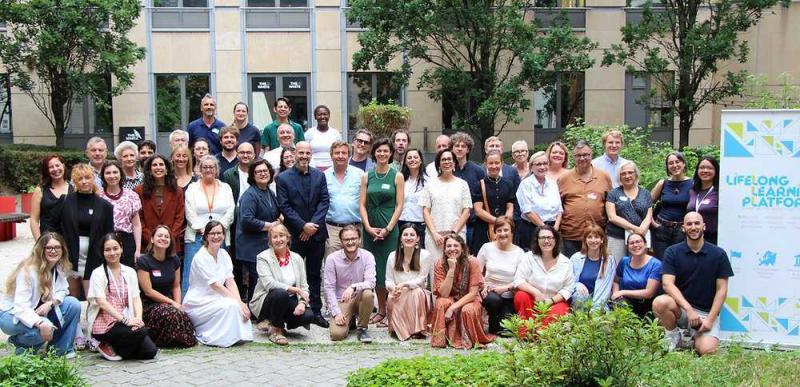
On 29 and 30 June 2026, ESN participated in the Lifelong Learning Platform (LLLP) General Assembly in Brussels, where member organisations, European policymakers, education stakeholders and civil society representatives came together to discuss the future of education, skills and lifelong learning in Europe. Representing ESN, Simone Lepore, President of the Erasmus Student Network, and Zoi Papakonstantinou, Liaison Officer for Skills & Lifelong Learning, took part in the two-day event, contributing to discussions on key developments and priorities shaping European education and training policy.
As a member of the Lifelong Learning Platform, ESN works alongside organisations from across the education and training sector to advocate for inclusive, high-quality and accessible lifelong learning opportunities. Through this collaboration, ESN brings the perspective of international students to European policy discussions, ensuring that student mobility, inclusion and skills development remain at the heart of education policies.
The gathering opened with a High-Level Policy Debate at the European Parliament, hosted by MEP Victor Negrescu, Vice President of the European Parliament, in his capacity of co-chair of the Intergroup on the Future of Education and Skills for a Competitive Europe, focusing on Artificial Intelligence in education and training. Policymakers, researchers, educators and technology experts exchanged views on how AI is transforming learning environments and highlighted the importance of ensuring that technological innovation remains learner-centred and supports rather than replaces human development.
For ESN, these discussions are particularly relevant as digital transformation increasingly shapes the mobility experience of international students, from learning environments to the recognition of skills and competences acquired during mobility.
Following the High-Level Policy Debate, the General Assembly brought together member organisations to address and approve the strategic and organisational priorities of the Lifelong Learning Platform.
Members unanimously approved the financial reports and programme documents, elected the new members of the Steering Committee, and welcomed three new organisations to the platform: Lie Detectors, Cooperatives Europe, and the garagErasmus Foundation.
An important milestone of this year's General Assembly was the adoption of amendments to the LLLP Statutes and Internal Rules. The changes introduce new membership categories, including Observer Members, broadening opportunities for national-level organisations to engage with the Platform and strengthening its representation across Europe.
During the General Assembly participants also took part in a series of interactive World Café and plenary discussions focusing on some of the most pressing challenges facing the education and training sector. Topics included the current attacks on NGO funding, the next EU budget negotiations, the Competitiveness Agenda and the Union of Skills, and the role of education and training networks in the current political context. ESN actively participated in these discussions, exchanging perspectives with fellow member organisations and reflecting on how these developments will shape the future of education, student mobility and civil society cooperation across Europe.
For ESN, participating in the General Assembly provided valuable insight into the Platform's future direction and reinforced our commitment to collaborating with organisations across the lifelong learning sector to advocate for high-quality, inclusive and accessible learning opportunities for all learners.
Follow ESN